

What is AEO?
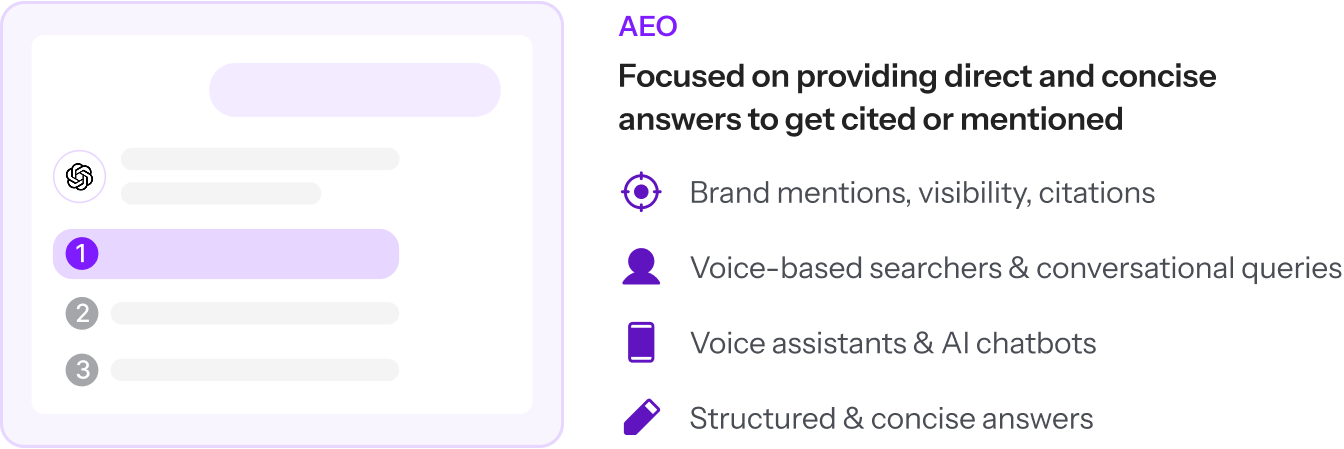
Answer engine optimization (AEO) is the process of optimizing your website for AI-powered engines like ChatGPT, AI Overviews, and more. It involves doing things like building FAQs, structuring content for answer-first, and integrating data for extraction.
What is SEO?
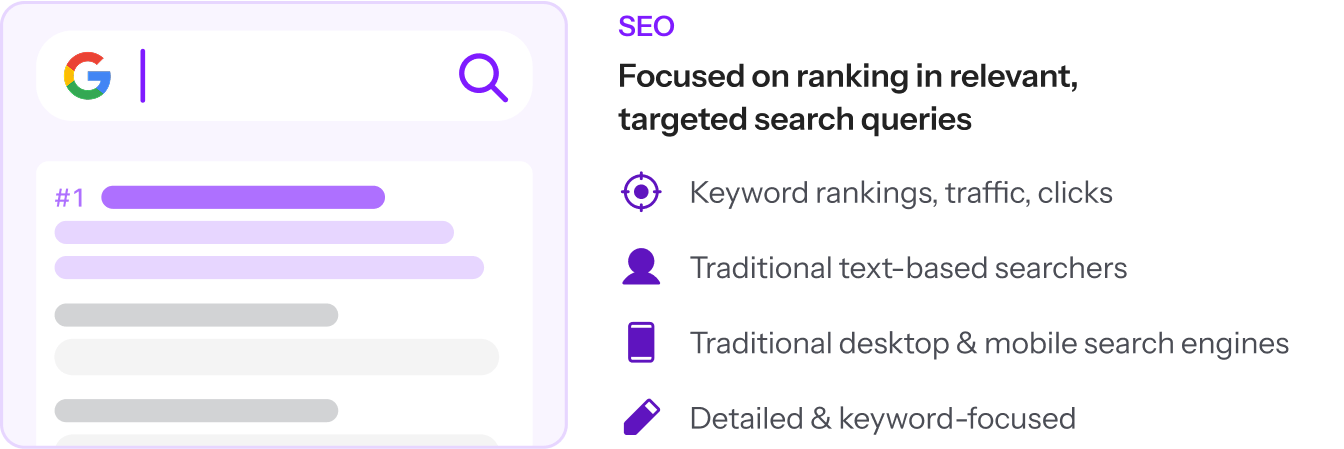
Search engine optimization (SEO) is the process of optimizing your website for organic search results. It involves strategies like keyword targeting, schema updates, and creating helpful content.
AEO vs. SEO: The difference between the two
AEO and SEO have a lot of overlapping areas they share — at the end of the day, they’re both aiming to help you perform better in search results.
A good SEO strategy will take you far with getting in answer engines, but AEO helps you get further. AEO helps you build your content to get easily extracted and parsed by AI engines, so you get cited in responses.
| AEO | SEO | |
| Focus and objectives | Provide direct and concise answers to get cited or mentioned | Rank in relevant, targeted search queries |
| User targeting | Voice-based searchers and conversational queries | Traditional text-based searches |
| Devices targeted | Voice assistants and AI chatbots | Traditional desktop and mobile search engines, like Google and Bing |
| Content format | Structured and concise answers | Detailed and keyword-focused |
| KPIs and metrics | Visibility, brand mentions, citations | Keyword rankings, organic traffic, and click-through rate |
| Goal | Get brand visibility within engines | Drive traffic through clicks |
| Platforms | AI Overviews, ChatGPT, Gemini, Claude, AI Mode, Perplexity, Copilot | Google, Bing |
| How to measure | Tools like OmniSEO®, Otterly.ai | Free tools like Google Analytics, Google Search Console, or paid tools like Ahrefs, Semrush, etc. |
| How long to results | 2-6 weeks to start seeing citations | 3-6 months to see rankings |
2.3 Million Keywords Show Why You Need to Use AEO
You might think, do I even need to worry about AEO? Isn’t SEO enough?
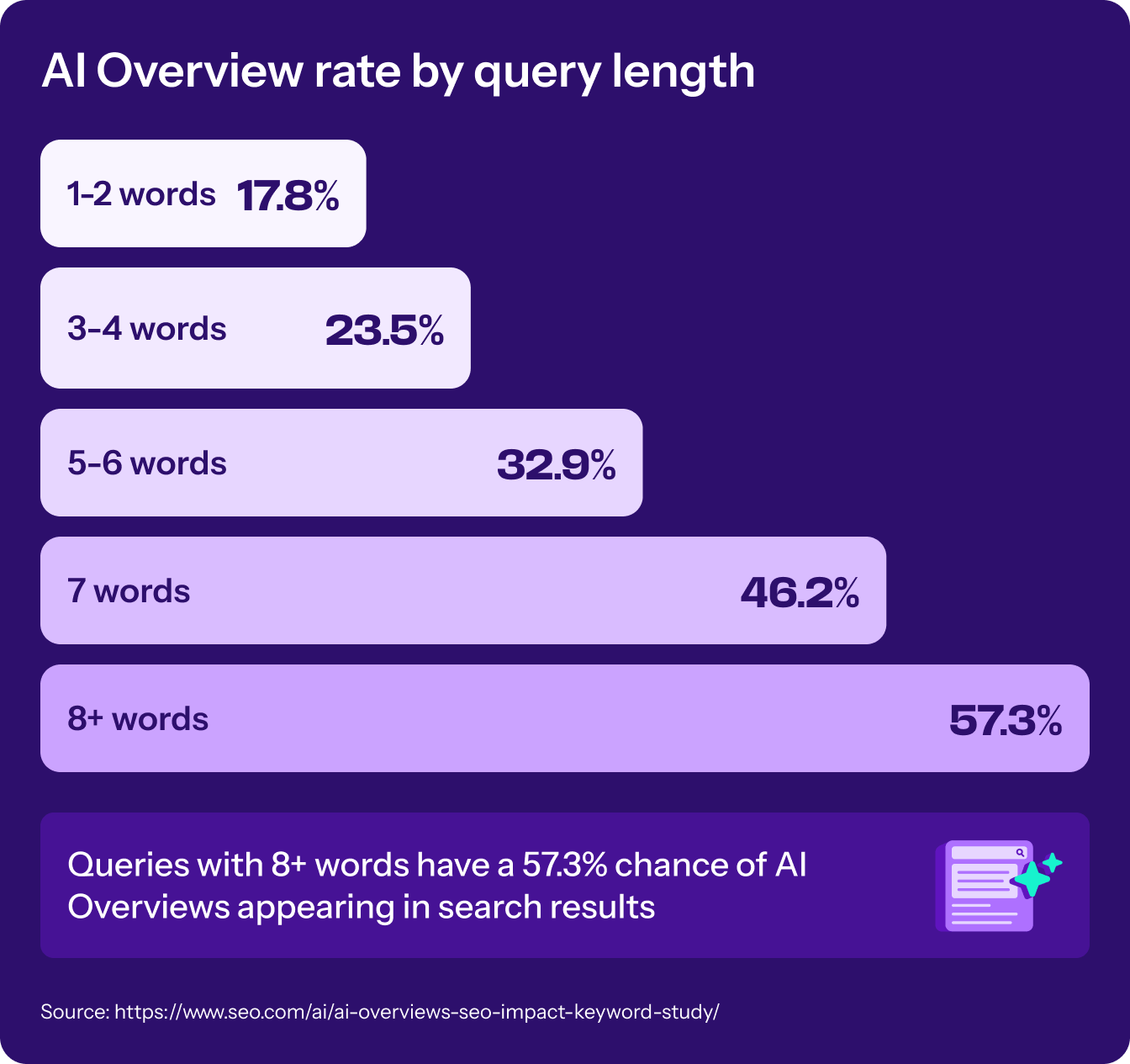
Well, an AI Overviews study we conducted shows that AI Overviews are increasingly growing in Google alone.
If there’s one thing we’ve learned about AI search, it’s that people search much longer and more elaborative queries. With that, comes more AI Overviews. Our study found that queries with 8+ words had AI Overviews appear in 57% of responses.
On top of that, informational queries see AI Overviews 67% of the time.
If this data shows anything, it’s that AI-powered responses are only continuing to grow. So, if you aren’t using AEO to show up in these answers, you’re practically invisible to your audience.
SEO alone isn’t going to cut it. You need to do optimizations specific to AI search to ensure you’re getting mentions, citations, and visibility where it matters most.
"AEO isn't 'replacing' SEO, but rather, supporting it. Foundational SEO is still critical for getting in traditional and AI-powered search, but isn't enough on its own. AEO helps bridge that gap. It's possible that someday the strategies will fully merge together and maybe just be called 'SEO' but include both strategies."

Dan Shaffer
Sr. Director, SEO.com

Does AEO replace SEO?
No, AEO doesn’t replace SEO. Right now, they’re two strategies working towards the same goal: Getting you visible in search results. SEO tactics are the base, while AEO strategies help specifically with AI-search aspects.
AI search takes different factors into consideration than traditional search. It’s factoring things like brand trustworthiness, uniqueness of content, and more, that traditional search didn’t really factor in with rankings.
So, SEO is a good base to start optimizing for search, but AEO enhances it by helping you optimize for factors AI search engines specifically consider.
AEO & SEO in action: How to do both
So, how can you balance AEO and SEO? Here’s a walkthrough of how the team behind SEO.com (WebFX) did it for a lawn mower client, RC Mowers.
Another thing RC Mowers got was AI-optimized blog posts. AI engines favor content that is easily extractable and answer-first. It’s a new way of structuring content, which means old content needs to be optimized for it, too.
So, we went to work optimizing RC Mowers content to ensure that it was ready for AI engine extraction. We helped them revamp their content to put the answer first, so AI engines could find information fast. We also helped revamp the structure of their content to ensure it was easily readable and parsable to help increase citation opportunities.
A key component of a successful AEO strategy is building brand mentions. AI engines aren’t going to take your word for how great you are — they want other people to say it, too. AI engines are consulting reviews, third-party sites, and editorial websites to get an idea of what people are saying about your brand.
So, we went to work helping RC Mowers build up brand mentions across the web. Our earned media team helped them gain links to valuable seed content and get mentions across the web to help build their authority.
Tracking your performance in AI engines is a crucial step for understanding your visibility. If you don’t know where you’re appearing in AI engines, you can’t make improvements or know if what you’re doing is working.
To help RC Mowers keep on top of their AI search visibility, we got them hooked up with OmniSEO®, an AI visibility tracking platform. They were able to see how they stacked up to the competition, what prompts they’re showing up for, and more.
How to track AEO to see if it’s working

Pick which prompts to track
Prompts are a key component to determining your AEO success. You need to decide what prompts you want to show up for and then track your visibility for those prompts. With the right AI visibility tool, you can track your mentions and citations across AI search platforms.

Determine what competitors to monitor
Part of tracking AEO success is seeing how you’re stacking up to competitors in places like AI Overviews and ChatGPT responses. Determine who your top competitors are in AI search results, keep tabs on them, and see how you’re performing compared to them. If they’re outperforming you, use it as an opportunity to explore what they’re doing and get ideas for improving your AEO strategy.

Determine what platforms matter most
You don’t need visibility on every AI search engine, just the ones your audience uses the most. Determine what platforms you want to be visible on the most and monitor your visibility on those engines.
FAQs on AEO vs. SEO
What are AEO and SEO trends for 2026?
Some popular AEO trends for 2026 include:
- Growing conversational-based content
- Contextual relevance taking center stage
- Zero-click search continuing to grow
- AI Overviews appearing in more searches.
For a full list of AI search trends, see our post.
How does measuring AEO differ from measuring SEO?
When you invest in AEO and SEO, you want to measure your performance to ensure your strategy is working. If you’ve measured SEO performance before, you may be wondering how measuring AEO performance differs.
So, what does measuring AEO look like?
Here are some key metrics you track with AEO:
- Visibility: Your overall visibility indicates how often you’re being seen in AI search results.
- Share of voice: This metric indicates how prominent you are in the AI search space compared to your competitors. It measures how much real estate you take up in AI search results compared to your competition.
- Mentions: This measurement shows you how often you’re mentioned in AI search results.
- Citations: Measuring citations enables you to see how often AI cites your pages in search results.
- Prompt coverage: Prompt coverage helps you understand the percentage of prompts you’re appearing in that you actively target.
In contrast, SEO focuses mainly on keyword rankings, clicks, and traffic.
Can AEO and SEO work together?
No — AEO is not replacing SEO. It’s building on the foundational principles of SEO to deliver more direct and concise results to users using AI chatbots and voice searches. SEO’s ongoing value — from brand awareness to qualified traffic to revenue — remains intact, and for most businesses the right move is to strengthen SEO while layering AEO on top.
What are the benefits of using AEO alongside SEO?
Optimizing for both AEO and SEO ensures your content appears on traditional search engines, AI-powered search engines, social media search engines, and voice search assistants. This provides businesses with visibility everywhere as part of a broader digital marketing strategy.
- Do I Need AEO? Not sure if you need AEO? Learn why you do.
- How to Build AI Citations Learn how to get cited in more AI responses
- How to Track AI Search Rankings Discover how to keep tabs on your AI visibility
- AI SEO vs. SEO: How They Compare See the similarities and differences between the two
- Why Am I Not Being Cited in AI Answers? Discover why AI may be passing over your brand
Prepare your search strategy for answer engines
AEO is here to stay — more people will start using answer engines to help them do research and find the information they need to make decisions. So if you aren’t visible on those engines, you’re missing out on prime leads for your business.
So, now is the time to create a joint AEO and SEO strategy that helps you stay visible across all search engines.
That’s exactly what our AEO services do. Backed by the search experts at WebFX, our AEO services help you increase brand visibility, mentions, and citations to capture attention across all search engines.
Curious to learn more? Connect with us today to discover how our AEO services can make the difference for your business!