


What is answer engine optimization?
Answer engine optimization (AEO) is the process of optimizing your website to appear in answer engines like ChatGPT, Claude, and Gemini, as well as AI Overviews. The goal is to make it easy for AI engines to crawl and understand your pages, so they’ll cite or mention you in responses.
Why is answer engine optimization important?
Answer engine optimization is important because search is changing. From AI platforms to AI assistants, users have options when it comes to researching problems, discovering brands, and purchasing products.
This shift emphasizes the need for search everywhere optimization, ensuring that content is accessible and relevant across various platforms.
You can see this shift in recent studies, which have discovered that:
- 400+ million people use OpenAI products each week (Source)
- 4x is how much downloads for Bing’s mobile app grew after integrating AI (Source)
- 45% of Millennials use social media for search (Source)
- 25% of organic traffic will shift to AI chatbots and other virtual agents by 2026 (Source)
Answer-focused sites like Stack Overflow have seen this change in user behavior first-hand. Following ChatGPT’s launch, the site’s visits decreased by 14% in March 2023 and then by 18% in April 2023.
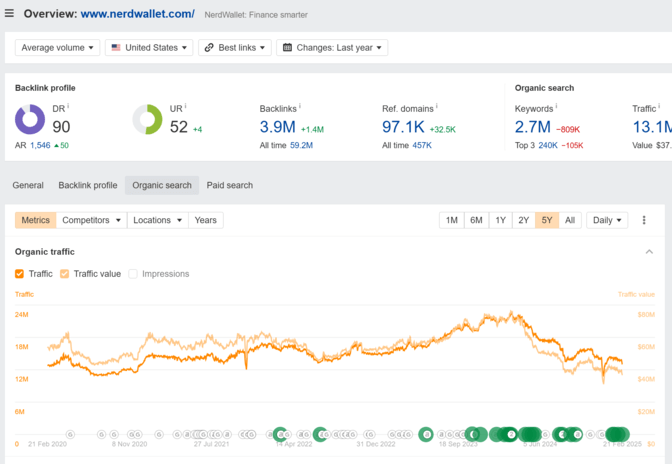
Even though companies are seeing declines in organic traffic, their revenues are growing.
NerdWallet, for example, grew its revenue more than 35% in 2024 while monthly website traffic decreased by 20%. This trend in revenue up and traffic down emphasizes that users aren’t shopping less — they’re shopping differently.
That’s why companies deciding to shift their strategy now are helping their organization:
- Get a first-to-market advantage over late adopters
- Grow the brand’s visibility across online channels, from social to search to AI
- Support business growth, like through leads or revenue generated
Businesses practicing AEO have seen results like a 542% increase in leads from AI sources and a 385% increase in AI Overview visibility — demonstrating AEO’s growing impact on lead generation and brand discovery. View case study →
What is the difference between AEO and SEO?
There are a few differences between AEO and SEO, including:
| Area | AEO | SEO |
| Platform | Answer engines, like ChatGPT, Perplexity AI, and Microsoft Copilot | Search engines, like Google, Bing, and DuckDuckGo |
| User targeting | Conversational questions, like “what are some good restaurants in Iceland?” | Keywords, ranging from a few to several words, like “best restaurants in iceland” |
| Metrics |
|
|
You’ll find some similarities between the two, though, including:
- Goal: Better visibility is core to SEO and AEO. Whether in traditional search results on Google or AI-generated responses in ChatGPT, businesses want to meet users through online search experiences.
- Tactics: The two approaches use similar tactics, like producing authentic content, attracting reputable backlinks, and targeting specific phrases, which is why it’s worth practicing SEO and AEO.
- Skills: From content creation to audience research to data analysis, answer engine optimization and search engine optimization use some of the same skills to build brand visibility.
Learn more: AEO vs. SEO Key Differences and Importance in Digital Marketing
How to get started with answer engine optimization
Learn how to get started with answer engine optimization now:
1. Set goals and KPIs
You’ve got the green light to optimize for answer engines, which means determining:
- What goals will define your success
- Which metrics will measure your performance
Since answer engine optimization is a newer strategy with limitations (like reporting), we recommend setting modest goals, like earning 1-2 mentions for a related set of questions, and accessible metrics, like citations, mentions, and referral traffic.
Consider setting goals with a three-month or quarterly timeline. This timeline should provide some initial insights, like the amount of referral traffic from answer engines, and potentially bolster support for AEO efforts.
2. Develop a strategy
Next, build an initial strategy, starting with some research steps like:
- Auditing the site’s existing SEO
- Researching the conversational questions to target
- Understanding the target market’s preferences for different engines, like Meta AI vs. Claude
- Analyzing competitor visibility
Using this data, outline where to focus the team’s (or your) time and resources.
For example, is focusing on Meta AI visibility more important because of your target audience? Or, is repairing some SEO issues the biggest priority before starting AEO optimizations? And which optimizations warrant the most attention and time? (More on that next).
If your team lacks the specialized expertise to navigate these nuances, an LLM marketing strategy can help build a data-backed roadmap to capture citations in conversational search engines.
P.S. Before starting, set up AEO tracking on your website analytics platform, like GA4!
For GA4 users, this means creating a Custom Channel Group where there is a channel for:
- Referral Traffic
- Answer Engine Traffic
You can extract answer engine traffic from existing referral traffic using some regex (ask ChatGPT or another AI platform for help!). Just remember that the regex will need updating if / when new AI platforms come online, like DeepSeek.
3. Optimize on-site
The most effective on-site optimizations for AEO include:
| Area | Optimization |
| Discoverability |
|
| Content |
|
4. Optimize off-site
The most effective off-site optimizations for AEO include:
| Area | Optimization |
| Backlink profile |
|
| Local listings |
|
| Social media |
|
| Review management |
|
5. Evaluate performance
In most cases, businesses track AEO performance with the following steps:
- Search the conversational phrase in an answer engine
- Log whether the business is cited or mentioned
- Repeat the process in other answer engines
This process takes time, but there are alternatives. Tools like OmniSEO® can complete the above steps automatically, along with tracking competitor visibility for the same search phrases.
Either way, budget time for documenting and evaluating performance.
If results haven’t shifted after making optimizations, do some competitor analysis to determine what makes answer engines more likely to cite these competitors. Do these businesses, for example, have more unique content or authoritative mentions?
Consider taking similar steps when earning citations or mentions. What optimizations did the team complete? How does the content (if cited) compare to the other citations, and what could be done to improve our content?
This proactive approach will help your organization stay ahead of the competition.

Learn more: How to Rank on Answer Engines
Related resource: Explore the best AI visibility tools in 2025 to see how brands are measuring and improving their presence across AI-driven search and platforms.
FAQs on answer engine optimization
What makes AEO challenging?
AEO is challenging because:
- It’s difficult to track performance and know it’s working
- It’s hard to get internal buy-in for the strategy
- There are multiple AI engines to optimize for
How long does answer engine optimization take?
Answer engine optimization can take a few weeks to a few months to deliver results. Its performance depends on a website’s existing SEO, and from our experience, our AEO services help clients see those results faster by building on established best practices.
That’s because these sites have started the process of:
- Being discoverable to search and answer engine crawlers
- Producing relevant content for common topics within their industry
- Building an authoritative and relative backlink profile
- Claiming local listings and social media profiles
If search engine optimization is a new investment for your organization, consider focusing your resources there. Then, after mastering the basics, invest some resources into answer engine optimization.
Is answer engine optimization worth it?
Yes. With more people search on diverse engines, from ChatGPT to Claude to Google, investing in AEO is crucial for reaching those people where they are.
How does answer engine optimization work?
Developing these AI-powered engines started with training them on various data sets (you can think of this as a search engine’s index). OpenAI, for example, used publicly available Internet data and private information from third-party partners to train its ChatGPT models.
As a part of their training, these models “predict the next most likely word that might appear in response to a user request, and each subsequent word after that.” As OpenAI explains, for the sentence “instead of turning left, she turned ___,” the AI might suggest “right,” “back,” or “around.”
So, what does that mean for an SEO?
Just like contributing to a search engine’s index, SEOs need to contribute to an AI model’s dataset. So, when someone asks ChatGPT, “what are some good restaurants in Iceland?” your brand is the next most likely word.
Get discovered in answer engines with AEO & SEO
Congrats! You’ve learned the basics of answer engine optimization — and its correlation with ongoing SEO. Now, start growing your brand’s presence in ChatGPT, Microsoft Copilot, Perplexity AI, and more.
Ready to grow your brand’s presence in ChatGPT, Microsoft Copilot, Perplexity AI, and more? For AEO tracking and professional support, contact us online.

Future-Proof Your SEO Strategy with OmniSEO®
Goodbye search engine optimization, hello search everywhere optimization.

Future-Proof Your SEO Strategy with OmniSEO®
Goodbye search engine optimization, hello search everywhere optimization.
Writers